


A practical guide to supportive conversations
Our national day to ask ‘are you okay?’ is almost upon us.
We’re talking about R U OK Day (8 Sept), and although it happens only once a year, it serves as a timely reminder of how important regular wellbeing conversations are in the workplace.
Almost half of all Australian adults will face mental ill-health at some point in their lives, yet in a recent study, more than half (53%) of Australian workers would hide a mental or physical health condition for fear they will be judged or discriminated against.
With the increase of mental health issues since the beginning of the pandemic — anxiety and depression has increased by 25 percent globally (WHO, 2021) — providing mental health support is not only about retaining good people, it sends a powerful message about your organisation’s values.
Support in the workplace has been shown to have positive benefits for both individuals and the business, yet managers and team members often feel ill-equipped to check-in on their colleagues’ mental health.
Starting a conversation doesn’t have to be difficult, and if leaders familiarise themselves with what to say if a team member shares they are struggling, they can genuinely show empathy and help them access the support they need before they reach crisis point. Workplace relationships are integral to our wellbeing. We spend a lot of time at work and with our work colleagues, and they are often one of our key social networks.
To help leaders (and individuals) ask colleagues, ‘Are you ok?’ in a meaningful way, we asked TW Senior Consultant, Bri Hayllar, to share her valuable insights. Read on for practical steps you can implement today.
Recognise the Signs
Look out for changes:
• Behaviour changes, voice/tone, appearance, participation, mood/emotion.
Look out for discrepancies:
• When verbal and non-verbal cues don’t line up.
Practical Tips
- It is nearly always better to do something than to avoid it. If there is a problem, outcomes are better when addressed sooner.
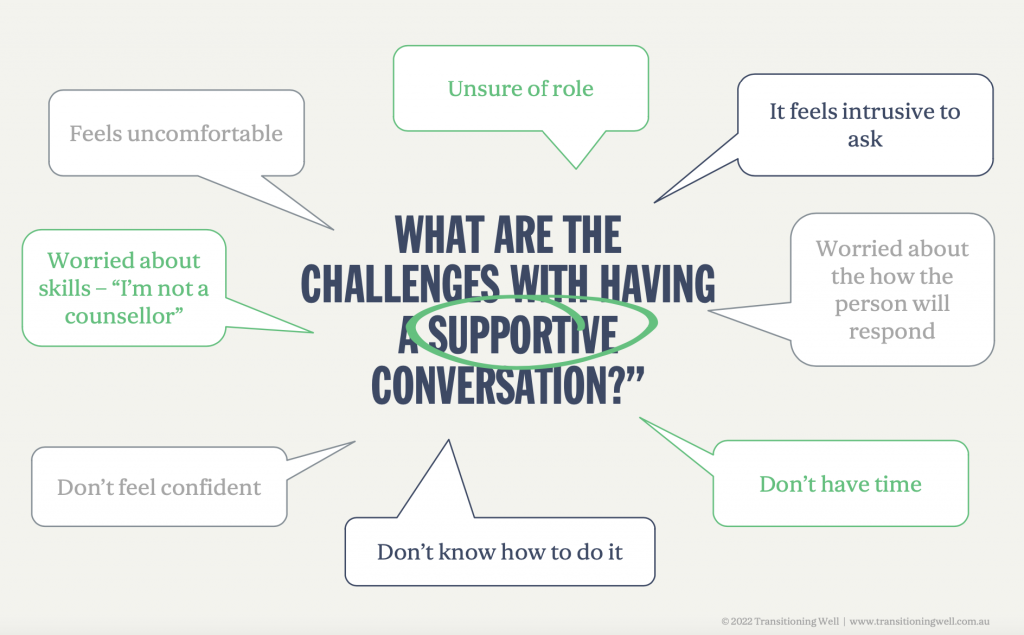
- Don’t try to be a counsellor – just be yourself!
- Be clear about what is and isn’t your role in the conversation.
- And be ready and willing to feel some discomfort – sometimes these supportive conversations can feel a little uncomfortable. As RUOK? Day say -” a conversation could change a life”.
Workplaces are not only legally obligated to provide a healthy and safe workplace both physically and mentally — it’s good for business.
At Transitioning Well, we offer a number of supports for managers and individuals to perform at their best and feel confident to engage in conversations that make a real difference. If you’d like to arm your team with the skills to create a culture of psychological safety, we recommend our latest workshop, R U OK Conversations: No Qualifications Needed.
If you’d like TW in your workplace in the lead-up to R U OK Day, reach out to us here, limited dates are available.