The post Addressing the Gender Pay Gap Through Better Transitions appeared first on Transitioning Well.
]]>By Dr Sarah Cotton
The release of the latest gender pay gap data from the Workplace Gender Equality Agency (WGEA) has prompted a lot of reflection across Australian organisations.
More than 10,500 employers with over 100 employees are now publicly reporting their gender pay gap performance, covering nearly 5.9 million Australian workers. The data highlights how closing the gender pay gap is not primarily about paying women and men differently for the same role. It’s also about who gets access to opportunity, progression, security, and leadership positions over time.
In other words, gender pay gaps are shaped by experience, not just policy and by the critical transitions people navigate across their working lives
What the WGEA data tells us
The latest WGEA report highlights several factors shaping gender pay gaps across Australian organisations.
- The midpoint of employer average gender pay gaps is 11.2%, with the median at 8.0%
- 54.8% of employers reduced their average total pay gap year-on-year
- Discretionary pay (like bonuses) continues to show the largest disparity, with a 29.7% gap in favour of men
- Men remain over-represented in senior and higher-paid roles
- Women continue to experience slower career progression linked to caring responsibilities and career interruptions.
- Taken together, the data reinforces a longstanding structural dynamic. Gender pay gaps are less about individual pay decisions and more about who progresses, who is rewarded, and who occupies senior and higher paid roles over time. Discretionary pay (including bonuses and allowances) plays a significant role, reflecting not just performance, but visibility, opportunity, and access to influence.
These patterns are rarely the result of a single decision. Instead, they emerge over time through a series of moments that shape career trajectories.
These moments are transition points where roles, identity, expectations and support structures shift, often subtly, but with long-term consequences.
At Transitioning Well, we think about the gender pay gap through the lens of key transitions, or ‘moments of truth’ that have the potential to derail, but also provide opportunities for significant personal and organisational growth.
Why transitions matter in closing the gender pay gap
Pay gaps don’t emerge from a single salary negotiation. Gaps accumulate in the spaces between roles. In the return from parental leave that quietly sidelines someone for the next promotion. In restructures that push experienced women out. In work environments that don’t support a women through menopause or other health transitions. In the step into leadership that occurs without adequate support, or doesn’t occur at all.
Transitions determine:
- Who stays and who leaves
- Who progresses and who plateaus
- Who feels supported and who disengages
- Who gains access to leadership pathways and who does not and who stays still
WGEA’s Ages and Wages report, released late last year, also makes the cumulative toll hard to ignore. The financial cost of the gender pay gap accelerates across a woman’s lifetime, peaking in the late 50s at a difference of $53,000 a year, with a key turning point identified at age 34. What this shows is how women navigating multiple transitions often absorb the cost of systems that were not designed with their realities in mind, unless organisations intervene deliberately.
This matters at the leadership level too. Just 22% of CEOs are women, and while 43% of managers are women, that figure drops sharply at senior levels (WGEA 2025). Supporting women through the transition into leadership, not just placing them into roles, is one of the most direct and underutilised levers available to organisations. Sustainable change requires action that addresses how people are recruited, promoted, supported, and retained and transition through their careers.
What organisations can do
WGEA is clear that analysing pay gap data is only the starting point. The harder work is knowing where to act. What we see at the coalface is that the organisations making the most progress are looking beyond policies, targets and reporting frameworks. They’re examining the day-to-day experiences that shape career progression, and treating the moments of transition as the place where inclusion takes hold (and where it quietly doesn’t).
For example, leadership transitions. Each passage through the leadership pipeline, from learning to lead to being a leader of leaders and becoming an executive or partner, requires a fundamental shift in identity, values and ways of working. What made someone successful at the previous level doesn’t automatically or always transfer. And that gap, when unacknowledged and unsupported, is where confidence can falters and capable people hesitate or step back.
For women, this can carry additional weight. The pressures and challenges of life as a female leader by managing perceptions, navigating competing demands during periods of organisational change don’t arrive in isolation. They arrive alongside everything else: health changes, caring responsibilities for both kids and ageing parents, and in the moments where professional identity and personal life pull in different directions all at once.
By intentionally supporting people through the key transitions that define their working lives, organisations can address some of the most persistent and preventable drivers of the gender pay gap and build workplaces where talent, not circumstance or gender, determines outcomes.
The post Addressing the Gender Pay Gap Through Better Transitions appeared first on Transitioning Well.
]]>The post Role design: How to make work more parent-friendly appeared first on Transitioning Well.
]]>Picture this: You’re a working parent managing two school-aged children. Your phone buzzes. Another class WhatsApp message – one of 2,914 you’ll receive this year.
“Parents, brace yourselves,” warns Georgie Dent, CEO of The Parenthood. Beyond those relentless messages lies an even bigger challenge: “1,244 invisible admin tasks — planning school pickups, managing extracurriculars, booking medical appointments.” Add it all up, and working parents are performing three months of unpaid, unseen labor on top of their regular jobs. The price tag for this invisible work? A staggering $10,990 at minimum wage.
This invisible mental load is crushing working parents worldwide, manifesting as a constant cycle of stress, overwhelm, and guilt. While the landscape of work has changed in the last few years, the challenge of managing this unseen labour alongside professional responsibilities remains unsolved. The post-pandemic era has ushered in lasting changes to how we think about work, family, and the integration of both—but has it done enough to address this hidden burden?
Not really.
For all our modern progress, we still aren’t setting up parents to flourish at work. But wouldn’t it be great to set up working parents for success rather than failure?
We can, and that’s where role design comes in.
Organisations today are responsible for addressing and mitigating workplace psychosocial hazards—including role design. Psychosocial hazards refer to work aspects that can harm employees’ psychological health and wellbeing. These hazards include workplace stress, bullying, harassment, excessive workload, and inadequate support systems.
Role design is the secret sauce to keeping your working parents engaged and happy. Ok, onsite childcare, autonomy and flexibility go a long way too.
What is role design?
Role or job design refers to the duties and tasks required to perform a role and how those tasks and duties are structured and scheduled.
Role design helps to determine what tasks are done, how the tasks are done, how many tasks are done and in what order the tasks are done.
Principles of good role design:
- Actively involve the people who do the work.
- Engage decision makers and leaders.
- Identify hazards, assess and control risks, and seek continuous improvement.
- Learn from experts, evidence, and experience.
Approaches to role design include:
Job Enlargement: Job enlargement changes the jobs to include more and/or different tasks. Job enlargement should add interest to the work but may or may not give employees more responsibility.
Rotation: Job rotation moves employees from one task to another. It distributes the group tasks among a number of employees.
Enrichment: Job enrichment allows employees to assume more responsibility, accountability, and independence when learning new tasks or to allow for greater participation and new opportunities.
Work Design (Job Engineering): Work design allows employees to see how the work methods, layout and handling procedures link together as well as the interaction between people and equipment/technology.
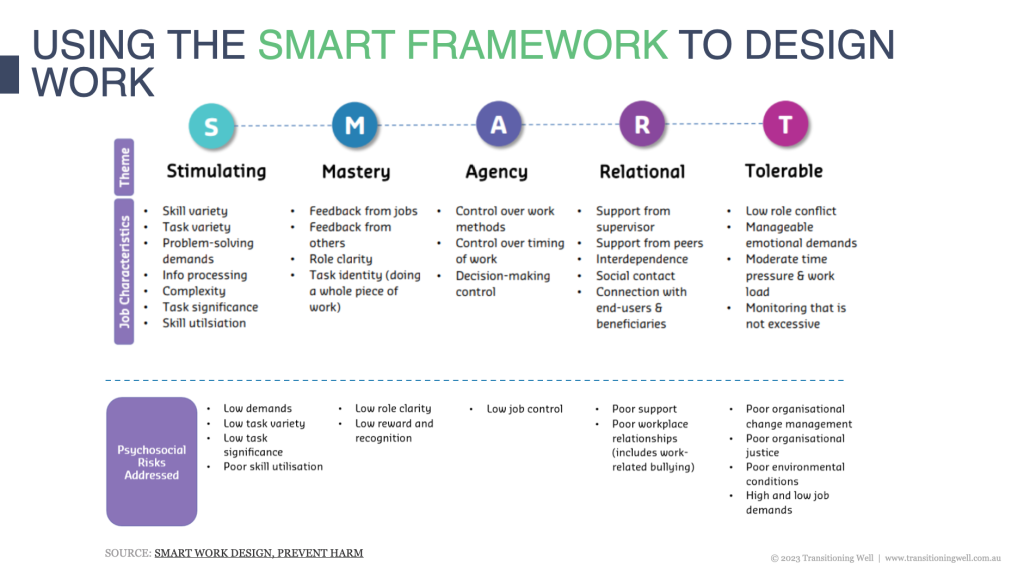
The Smart Framework
Using the SMART framework in designing effective work involves setting Specific, Measurable, Achievable, Relevant, and Time-bound goals, ensuring clarity, accountability, and a structured approach that enhances productivity and success in the workplace.
Increase job resources:
- S Provide stimulating work.
- M Provide mastery resources.
- A Provide agency.
- R Foster relational resources.
Ensure tolerable demands:
- T Create tolerable job demands – load and time, emotional, role, cognitive, environment and physical, and relational.
- Create tolerable organisational demands – organisational change, organisational justice and job security.
Why it matters
Returning to work after parental leave can be a daunting prospect, as parents often face the dual challenge of readjusting to professional responsibilities while ensuring the wellbeing of their growing families.
“Supporting parents with their return to work is not just the right thing to do, it’s the smart thing to do,” says our co-founder, Justine Alter.
“Put simply, if you don’t support parents, you will lose them,” she says. “Employees want to know that there’s a culture of support for them. That could mean flexibility, it could mean clear pathways to promotion, or it could be something else entirely. It’s going to be different for everyone. What remains the same is that need for a culture of support. And organisations that don’t offer that, that don’t support parents, won’t attract or retain the best talent.”
What working parents want
Autonomy
When autonomy is incorporated into role design, people are empowered to make decisions, set goals, and determine how they accomplish their work.
Autonomy at work offers several benefits:
- It enhances job satisfaction by giving individuals a sense of ownership and control over their work. This, in turn, contributes to increased motivation and engagement.
- Autonomy fosters creativity and innovation as employees have the freedom to explore different approaches to their tasks.
- It promotes a healthier life-work integration as individuals can tailor their work to better suit their personal needs and responsibilities.
There is a caveat to this — the level of autonomy should be balanced, as excessive autonomy without appropriate guidance or support may lead to feelings of isolation or uncertainty. Striking the right balance in role design, where employees have a reasonable level of autonomy coupled with clear expectations and support systems, contributes to a more effective and satisfying work environment.
Flexible work arrangements
One of the key aspects of crafting role design for returning parents is flexible work arrangements. This may include options such as remote work, flexible hours, or compressed workweeks. Such flexibility supports work-life integration and empowers parents to manage their responsibilities at home while meeting their professional commitments.
Some helpful tips:
- Encourage employees to be open about what they need in terms of work/life integration.
- Curiosity and respect will go a long way when having conversations with employees.
- Ask, don’t assume!
- When considering the needs of working parents, don’t forget about fathers and non-birth parents.
Find all our practical guidance and resources for supporting parents and carers in the workplace here.
The post Role design: How to make work more parent-friendly appeared first on Transitioning Well.
]]>The post How to navigate the transition to daycare and school appeared first on Transitioning Well.
]]>Whether you’re preparing for daycare drop-offs or navigating the first day of “big” school, here’s your comprehensive roadmap to making it work.
For many parents, the return to work after parental leave coincides with the availability of daycare spots. This period marks a significant time of transition as families adapt to new routines and roles.
In this article, we explore practical strategies for a smooth transition, emphasising the importance of preparation, communication, and self-care.
Transitioning to daycare
The golden rule? Don’t let your first day of work coincide with your child’s first day at daycare. Here’s why:
- You’ll want to be fully present during your child’s orientation phase
- Early transitions give you buffer time for unexpected adjustments
- The infamous “daycare immune system build-up” (yes, those early weeks of sniffles are real!)
“Trust me you’ll be grateful to have to time to be present or not be rushing to a meeting when your child might need you stay a little longer,” says Transitioning Well co-founder, Justine Alter.
Planning ahead allows you to be present during the orientation phase, rather than juggling work commitments and a child adjusting to a new environment simultaneously.
Remember, it’s not just the kids transitioning…
Use the orientation period strategically. While your child adapts to their new environment:
- Schedule personal appointments you’ve been postponing
- Take time to refresh your professional wardrobe
- Enjoy some quiet moments to mentally prepare for your return to work
Creating your family game plan
Having a well-thought-out transition plan is crucial for managing potential contingencies and ensuring a successful return to work.
Conversations with partners about shared care responsibilities and domestic duties should begin early to avoid stress and misunderstandings once work resumes.
“Once you’re back at work and tired, it makes these conversations a lot harder!” Says Justine. ‘Adopting the motto ‘ask, don’t assume’ with your partner encourages open communication, preventing disappointment stemming from unmet expectations.
Before diving back into work:
- Have detailed discussions with your partner about shared responsibilities
- Define clear expectations for household duties
- Adopt the “ask, don’t assume” principle for family logistics
For daycare:
- Practise the morning routine, including bag packing
- Create a visual schedule with pictures for young children
- Plan gradual increases in attendance hours
For Primary School Pupils:
- Arrange playdates with future classmates
- Introduce age-appropriate household responsibilities
- Involve them in packed lunch preparation and uniform organisation
For Secondary School Students:
- Encourage summer reading of set texts
- Help establish study routines before term begins
- Create a calendar system for managing assignments
Modern workplace support
Today’s organisations increasingly recognise the importance of supporting parents through these transitions. Look for and advocate for:
- Flexible scheduling options
- Remote work possibilities
- Autonomous work arrangements
- Parent-friendly meeting schedules
- Understanding of occasional disruptions
Building Resilience
Remember that transitions take time. Some days will flow smoothly; others might feel chaotic. What matters is building sustainable routines that work for your family’s unique situation.
Consider documenting what works and what doesn’t. This “transition diary” can help you adjust strategies and might even help other parents in your network.
Looking Forward
The key to successfully navigating these transitions lies in preparation, flexibility, and open communication. Whilst the initial weeks might feel overwhelming, remember that thousands of families successfully manage this journey every year.
By taking a proactive approach and utilising available support systems, both at home and in the workplace, you can create a balanced routine that works for everyone involved.
To find out more about how Transitioning Well can help support parents and carers in the workplace, take a look at the Parents and Carers page.
The post How to navigate the transition to daycare and school appeared first on Transitioning Well.
]]>The post Opinion: Businesses Have To Do More For Dads To Take Parental Leave appeared first on Transitioning Well.
]]>By Justine Alter
First published in The Age.
The Workplace Gender Equality Agency (WGEA) recently released its annual update on the state of workplace gender equality. It revealed the average total remuneration gender pay gap dropped to 21.7% in 2023. While small, it’s still progress – the biggest shift since 2014.
What we can’t ignore from this report and what we know from our parental leave coaching is that the number of men taking paid primary carer parental leave has barely shifted. The report shows there’s only been a 0.6% increase from 2022.
Why is this the case?
Put simply, we have more to do more to help organisations be ready for dads to take parental leave in Australia.
As a practitioner in this space, there is so much more to do culturally and holistically within organisations. While the uptake in dads taking more parental leave is great, we need the structure to be built and the scaffolding to be there before it’s successful.
To enable this, organisations need to invest in manager training to upskill their leaders to handle the complex psychosocial hazards and risks that arise in the parental leave transition.
Job demands are a huge risk factor in many new parents leaving or dropping out of the workforce altogether. So often, we see parents returning to work and being offered flexibility, but that often comes with conditions like working five days of work in four days (and getting paid 80% for the privilege- this is a different situation to an actual agreed compressed work week where the role and job demands are considered and altered accordingly). The reality is, you can’t perform in the same way at the same pace, especially at a high level.
We have more to do more to help organisations be ready and successful for men to take parental leave in Australia.
Managers with dads who wish to come back part-time or work flexibly need to ask: What will we do about his job demands and role clarity when he returns? What supports do we have in the team so he can protect his boundaries around on his day off? What’s in place so he feels accepted for his parental leave? How are we changing the KPIs to reflect their current capacity?
Employees want to know that there’s a culture of support. That could mean flexibility, it could mean clear pathways to promotion, or it could be something else entirely. It’s going to be different for everyone. The first step is having open communication with the employee and allowing them to feel supported from the outset. It’s vital in order to attract and retain talent, focus on the unique needs of the person and how you can work together to meet these and the needs of the business in a way that works for all.
With the best intentions, lots of companies have great policies that just end up sitting on the shelf or the intranet. Leaders need to ensure policies are kept up to date with new legislation and are well implemented and communicated. Workplaces need to encourage both parents to take leave and support them with parental leave coaching, especially dads.
WGEA’s Chief Executive Officer Mary Wooldridge says, “If we want real change, we need employers to take bold action. We need employers to look across the drivers of gender inequality and be imaginative in their solutions.”
I agree wholeheartedly. If organisations are truly serious about creating lasting gender equality, they must consider what they can do to make it successful. Organisations have to see the many benefits of creating meaningful change for society to catch up.
Common psychological hazards in the parental leave transition
Work-related factors, also known as psychosocial hazards, are anything in the management or design of work that increases the risk of work-related stress, which can lead to physical injury, mental injury or even both at the same time.
Helping employees stay connected during Parental Leave can help reduce common work-related factors such as:
- Low job control.
- Poor support.
- Poor organisational change management.
- Low recognition and reward.
- Low role clarity.
- Poor workplace relationships.
- Poor environmental conditions.
- Discrimination
Find out more about how Transitioning Well can help support working parents in your organisation.
The post Opinion: Businesses Have To Do More For Dads To Take Parental Leave appeared first on Transitioning Well.
]]>The post 5 Key Skills for Leading Early-Career Talent appeared first on Transitioning Well.
]]>Young workers are the future of our workforce. Are we giving them the leadership they need to thrive?
The need for good leadership transcends generations. Regardless of age, employees crave guidance, inspiration, and a supportive environment to thrive.
Generation Z, the first generation born entirely in the 21st century, is rapidly entering the workforce. Younger generations will face a more dynamic and constantly evolving work landscape compared to their predecessors. Therefore, equipping them with the skills and resources to navigate this change in a healthy and sustainable manner is crucial.
These digital natives bring a unique set of values, expectations, and skills that challenge traditional leadership styles. Understanding how to effectively lead this generation is can assist in creating a thriving and engaged work environment. We know for those in the early career phase, their success hinges heavily on the leadership they receive.
While numerous factors contribute to overall organisational health, studies consistently highlight the crucial role leaders play in supporting and guiding early-career individuals. This article explores five key leadership strategies, supported by research, that resonate with young professionals, fostering their engagement, motivation, and growth.
1. Champion a Transformational Leadership Style
Transformational leadership, characterised by its focus on individual growth and fostering a sense of purpose, has been found to be effective in supporting young workers 1,2. Leaders who embody this style actively seek opportunities to empower their team members through coaching, highlighting strengths, and setting clear expectations while encouraging open communication 3, 4.
This approach aligns with the intrinsic motivators often present in younger workers, who crave opportunities to learn, grow, and contribute meaningfully 5. Research suggests that transformational leadership fosters a sense of psychological safety, allowing young workers to feel comfortable taking risks and voicing their ideas 6. This, in turn, can lead to increased innovation, collaboration, and ultimately, organisational success.
2. Embrace Flexibility and Individuality
Studies show that early-career professionals often value flexibility and autonomy 1). Leaders who demonstrate adaptability by offering employees some control over their work style and schedule (e.g., remote work options) can create a more engaging work environment. Additionally, research suggests that encouraging creativity and fostering a space where individuals can express themselves authentically can significantly impact young workers’ sense of belonging and satisfaction 6.
This aligns with the diverse personalities and preferences of younger generations entering the workforce. Offering flexible work arrangements caters to individual needs and acknowledges the evolving nature of work-life priorities. Additionally, fostering a culture of creativity allows young workers to leverage their unique perspectives and skillsets, leading to a more diverse and innovative team environment.
3. Cultivate a Psychologically Safe Environment
Psychological safety, where team members feel comfortable taking risks and offering diverse perspectives, is crucial for innovation and collaboration 6. Leaders who actively create this environment by fostering open communication, actively listening, and celebrating learning opportunities from challenges can unlock the full potential of their teams.
Research suggests that psychologically safe environments are particularly important for young workers, who may be hesitant to speak up or challenge the status quo due to a lack of experience or confidence 6. Leaders who actively promote psychological safety can create a space where young workers feel valued, respected, and empowered to contribute their ideas and perspectives. This, in turn, fosters trust, collaboration, and, ultimately, a more engaged and productive workforce.
4. Foster a Culture of Work-Life Balance
Leaders who acknowledge the importance of work-life balance for younger generations demonstrate empathy and understanding. Recent research by Deloitte 7
indicates that a significant portion of Gen Z and millennial employees prefer hybrid work models with clear expectations, highlighting the desire for flexibility AND structure. Additionally, studies suggest that redesigning job descriptions to reflect individual preferences and implementing regular feedback and recognition processes can contribute to a more engaged and motivated workforce 8.
Prioritising work-life balance demonstrates respect for young workers’ personal lives and well-being, ultimately increasing employee satisfaction and retention. It’s crucial to remember that a healthy work-life balance benefits not only the individual but also the organisation, as it can lead to reduced stress, burnout, and absenteeism, while fostering increased productivity and engagement.
5. Champion Mentorship and Development Opportunities
Mentorship programs and opportunities for supervised practice play a significant role in supporting early-career professionals. Research by Eby & Robertson 9 highlights the distinct benefits of mentorship, providing career guidance and personal and professional growth beyond what leaders alone can offer. Additionally, studies show that supervised practice, as reported recently by Justice Jayne Jagot 10, can be highly beneficial for young professionals, allowing them to learn and develop their skills in a supportive environment.
Investing in mentorship programs and development opportunities demonstrates a commitment to the long-term growth and success of young workers. Mentorship programs can provide valuable guidance, support, and networking opportunities for young professionals, while supervised practice allows them to apply their learning in a safe and controlled environment. Young workers report a desire for mentoring whereby they can refer to, and model, successful people’s behaviour, with many young workers choosing to work for a supervisor with leadership and mentoring capabilities 11, 12. Mentoring initiatives contribute to a more engaged and productive workforce, ultimately fostering a competitive advantage for the organisation in the ever-evolving landscape of the talent market.
By adopting these five leadership strategies, informed by research and best practices, HR and business leaders and managers can create a work environment that not only fosters the success, engagement, and long-term career development of early-career professionals but also positions the organisation as an employer of choice. Recognising and nurturing the potential of young talent is crucial for ensuring the sustainability and success of any organisation in the face of a rapidly changing workforce landscape.
References
1 Sessoms-Penny, S., Underwood, K. M., & Taylor, J. (2023). A decade later: exploring managerial insights on millennials. Management Matters, 20(1), 36–52. https://doi. org/10.1108/MANM-03-2022-0044
2 Yap, W. M., & Zainal Badri, S. K. (2020). What Makes Millennials Happy in their Workplace? Asian Academy of Management Journal, 25(1). https://ejournal.usm.my/aamj/article/view/93
3 Gallup. (2016). How millennials want to work and live. https://www.gallup.com/workplace/238073/millennials-work-live.aspx
4 Valenti, A. (2019). Leadership Preferences of the Millennial Generation. The Journal of Business Diversity; West Palm Beach, 19(1), 75–84.
5 Gagné, M., & Deci, E. L. (2005). Self-determination theory and work motivation. Journal of Organizational Behavior, 26(4), 331–362. https://doi.org/10.1002/job.322
6 Edmondson, Amy C. and Bransby, Derrick P., Psychological Safety Comes of Age: Observed Themes in an Established Literature (January 2023). Annual Review of Organizational Psychology & Organizational Behavior, Vol. 10, Issue 1, pp. 55-78, 2023, Available at SSRN: https://ssrn.com/abstract=4337247
7 Deloitte (2022). Global Gen Z and Millennial Survey. Country Profile: Germany. https://www2.deloitte.com/content/dam/Deloitte/de/Documents/Innovation/Deloitte%20Millennials%20Gen%20Z%20Survey%202022_GERMANY.pdf
8 Xu, M., Cao, X., & Lu, H. (2023). Leave or not to leave? The impact of managerial work life support and work engagement on the outcomes of work-to-life conflict for China’s new generation employees. Asia Pacific Business Review, 1-23.
9 Eby, L. T., & Robertson, M. M. (2020). The psychology of workplace mentoring relationships. Annual Review of Organizational Psychology and Organizational Behavior, 7, 75–100. https://psycnet.apa.org/doi/10.1146/annurev-orgpsych-012119-044924
10 Jagot, J. (2023). Burning bright without burning out. 2023 Minds Count Lecture.
11 Banović, S. R. (2022). Career development and mentoring in Croatia: Recent findings and pandemic implications. 375–392. https://hrcak.srce.hr/ojs/index.php/eclic/article/view/22435
12 Barhate, B., & Dirani, K. M. (2022). Career aspirations of generation Z: a systematic literature review. European Journal of Training and Development, 46(1/2), 139–157. https://doi.org/10.1108/EJTD-07-2020-0124
The post 5 Key Skills for Leading Early-Career Talent appeared first on Transitioning Well.
]]>The post Making a Difference: The Positive Impact of Parental Leave Transition Coaching appeared first on Transitioning Well.
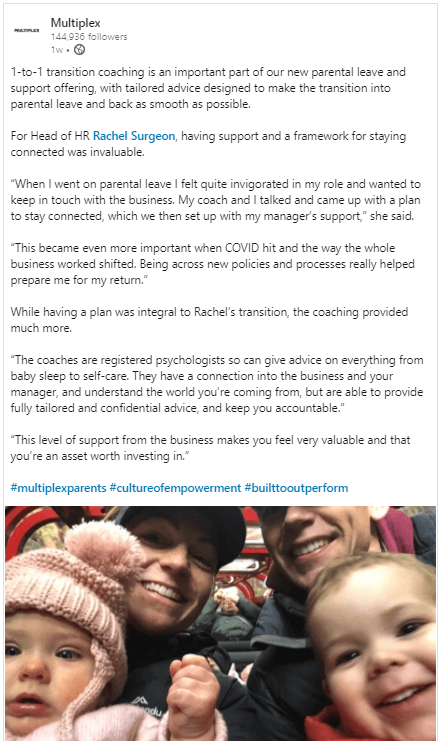
]]>We are so fortunate to work with conscious companies who understand that our parental leave transition coaching program makes such a difference to their people. Thanks Rachel Surgeon for sharing your experience.
The post Making a Difference: The Positive Impact of Parental Leave Transition Coaching appeared first on Transitioning Well.
]]>