


Rethinking work design to help prevent occupational violence and aggression
Community of Practice | Case study
How Catholic Healthcare’s Inspirit model is changing everyday care practices, giving residents more choice and helping teams rethink their approach to occupational violence and aggression.
When everyday care becomes a trigger
In aged care, a morning shower might seem like a routine task. But what happens when a resident doesn’t want one?
At Catholic Healthcare, more than 40% of reported staff incidents relate to what the organisation calls behaviours of concern. These include physical and verbal aggression and can involve residents, including people living with dementia or other cognitive impairment, as well as family members.
Amanda MacDonald, Senior Health, Safety and Wellbeing Manager, Catholic Healthcare, explains that many incidents involving residents occurred during personal care. Staff might prompt someone to get up, shower or get ready for the day when they aren’t ready or don’t want to.
For MacDonald, it raised an important question: were some of these situations being made worse by the way work was organised?
“If anyone dared do that to me on a cold winter's day in Bathurst, I probably would be cranky as well, right?” she says.
What looks like resistance can be a person communicating discomfort, distress or a need for more control.
“Residents should be heard,” says MacDonald. “They shouldn't need to escalate to actual physical aggression.”
Rather than focusing only on how employees respond when an incident occurs, Catholic Healthcare began rethinking how everyday care practices could help prevent some of these situations.
Understanding OVA in the workplace
OVA can occur wherever people are delivering difficult news, managing complaints, or representing an organisation during a stressful moment in a customer's life.
6.5 times higher
The rate of workers’ compensation claims for assault is around 6.5 times higher for nursing, care and support workers than for people in all other occupations.
The risks facing care workers are reflected in national data. Safe Work Australia's 2025 profile of the nursing, care and support workforce found that the frequency rate of workers' compensation claims for being assaulted by another person was approximately 6.5 times higher than for all other occupations.
Tackling occupational violence and aggression remains a challenge across every industry. While many organisations have systems in place to respond when something goes wrong, these are often focused on what happens after an incident: reporting, escalation pathways and post-incident wellbeing checks. The challenge is to move beyond responding to harm and take a more proactive approach to prevention.
Putting the person at the centre of care
Catholic Healthcare’s Inspirit model is a relationship-centred approach built around the promise: We see you, hear you and know you.
Its four pillars, Health, Heart, Home and Hope, reflect a focus on each person’s wellbeing, relationships, independence, choice and sense of purpose.
A New Approach to OVA: RELAXED AWAKENING
One practical example is Relaxed Awakening, which gives residents more choice over when they wake up and begin their day. Residents may also choose not to shower on a particular day
The change challenges the assumption that everyone should follow the same morning routine.
As MacDonald explained, a resident might prefer to stay in bed on a cold winter morning and shower later, rather than get up at 7am simply because that is when the routine allows.
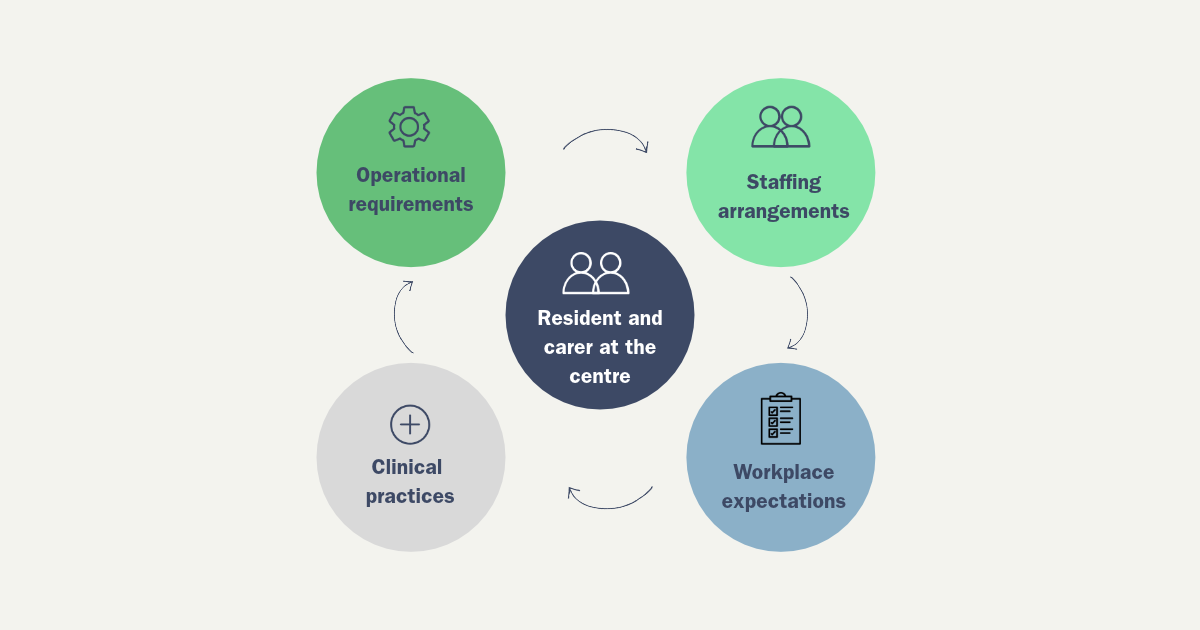
Giving residents more ownership over their day is consistent with Inspirit’s relationship-centred approach. It also creates an opportunity to reconsider how work is organised, including staffing arrangements, established routines and operational requirements.
"Under-reporting is a huge problem because occupational violence and aggression has been normalised."
Supporting workers to make safe decisions
Changing routines is only one part of the response. Catholic Healthcare has also been working to challenge the idea that aggression is simply part of the job.
MacDonald described how employees can feel compelled to stay in an aggressive interaction because they care deeply about residents and want to provide support. Leaving a situation, particularly when a resident is living with dementia, can feel at odds with that instinct.
Catholic Healthcare has been reinforcing that employees can leave a situation when it is safe to do so, and that managers need to support them in making that decision. It also recognises that people respond to situations differently. What one person might find manageable could be distressing or triggering for someone else, depending on their experiences and circumstances. The important thing is that employees feel able to recognise their own limits and know their manager will back them.
“Having permission to walk away is a really, really big piece,” says MacDonald.
The broader approach also involves improving incident reporting and looking for patterns, while bringing operational, clinical and work health and safety perspectives together. This helps the organisation consider how decisions and practices across the business may affect worker safety.
“There’s never going to be one solution. What we need is an entire suite of things that we can try and best fit to the situation at hand.”
THE IMPACT

Observed reduced in behaviours of concern

Less time spent providing support to on-site teams

Staff reported feeling heard and supported

Reduced risk of cumulative exposure
Catholic Healthcare observed a reduction in behaviours of concern in the homes where Relaxed Awakening was first introduced.
An update to their incident reporting systems means the reduction cannot currently be quantified; however, the experience provides a useful example of how a relationship-centred model of care can prompt teams to reconsider everyday practices that may contribute to difficult interactions.
It also reinforces that OVA prevention requires more than a single initiative.
Changes to work design need to sit alongside reporting, leadership support, worker safety and responses suited to the circumstances.
As MacDonald puts it: “There’s never going to be one solution. What we need is an entire suite of things that we can try and best fit to the situation at hand.”

Look beyond the incident to the work itself
Catholic Healthcare’s experience offers several questions for organisations looking to strengthen their approach to OVA:
-
Review established routines. Could the way work is organised contribute to distress, conflict or difficult interactions?
-
Consider what behaviour communicates. Is a person expressing discomfort, distress or a preference that has not been heard?
-
Bring different perspectives together. How might operational and clinical decisions affect worker safety?
-
Back employees to act safely. Do workers feel supported to report incidents and step away from unsafe situations?
-
Keep learning. Are reporting systems and team feedback helping identify patterns and inform changes?
Relaxed Awakening is one example, not a universal solution. Its value is in showing how a change grounded in residents’ choice and relationships can also prompt wider questions about work design and worker safety.
Sharing these experiences helps organisations learn from what others are trying, consider what may transfer to their own settings and build a broader range of approaches to preventing OVA.
Support that makes a difference
Wherever your people are absorbing the stress, frustration, or aggression of others as part of their role, Transitioning Well's national team of registered organisational psychologists can deliver tailored interventions designed around your workforce, your existing systems, and the specific psychosocial hazards your people may face.
Get in touch to find out how we can support your team.